
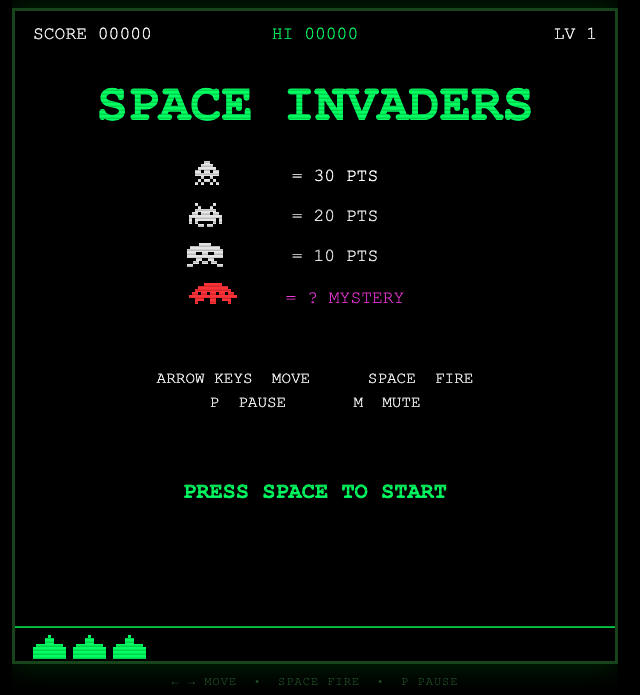
Remember the classic Space Invaders game from the 1970s? Well, I thought I’d do an interesting little test of AI systems.
I recently got my hands on an Asus Ascent GX10 AI box, which allows us to run inference locally, and not have to pay per-token. This means I can run the thing 24×7 with all the tasks I can dream up.
On this box I’ve installed Qwen3.6-35b which is a AI model written by the Chinese. Super-efficient, supposedly good at coding, knows 110 languages, and fits in 22GB of memory. I thought it time to have a coding test. My coding AI partner of choice is Claude, which has 3 models of ascending ability and cost called Haiku, Sonnet, and Opus. I wondered how Qwen would stack up against these in a simple challenge.
First I had a little chat with Sonnet to define the challenge, and came up with this prompt to feed to each model:
Create a fully playable Space Invaders clone as a single self-contained HTML file (HTML + CSS + JavaScript, no external dependencies). It should implement the classic arcade game faithfully: Gameplay:
- A 5×11 grid of invaders in three rows of different types, moving left/right and descending when hitting the edge
- Movement speed increases as invaders are destroyed
- Invaders randomly fire downward; rate increases as their numbers drop
- Player cannon at the bottom moves left/right and fires upward (one shot at a time)
- 4 destructible bunkers/shields with pixel-accurate erosion from both player and invader fire
- A mystery UFO crosses the top periodically for bonus points
- 3 lives; game over when lives are exhausted or invaders reach the bottom
- Scoring: 3 rows of invaders worth different points (10/20/30), UFO 50–300 random
- High score tracking (session only is fine) Technical:
- Canvas-based rendering
- Keyboard controls: arrow keys to move, spacebar to fire
- Classic monochrome/green aesthetic; classic invader sprite shapes
- Sound effects using the Web Audio API (no external audio files)
- A start screen and game-over/level-complete screen
And here are the results… Haiku and Sonnet’s first attempts were buggy and wouldn’t run, and they had to be prompted to go fix the bugs, which they did. Qwen and Opus ran straight away.
1st prize goes to Opus, with Qwen in 2nd, Sonnet in 3rd and Haiku in 4th. I think I’ll be doing my future coding with Opus, and maybe Qwen. Try them for yourself and see what you think…